Archives
-

Kairos: Evangelical Journal of Theology
Vol. 19 No. 2 (2025)The new issue of Kairos presents a diverse and stimulating collection of articles that connect biblical, theological, historical, and practical insights into the life of faith and the church.
In Enthroned Upon the Praises, Zachary Shaffer explores the functions of worship through the lens of temple theology in Revelation 4 and 5, showing how worship shapes our vision of the world as God’s temple. Benjamin D. Spector, in A Theological Vision for Discipleship, emphasizes that discipleship is God’s initiative and work, and that the practice of making disciples should be grounded in God’s Word, Spirit, and the life of the church community.
Kotel Dadon, in The Poetry of Suffering in Lamentations, offers a literary and theological analysis of the Book of Lamentations, viewing it as a key work of Jewish culture that connects historical trauma with the enduring question of faith in a just God amidst suffering. Iva Đaković presented the historical contribution in The Development and Activities of Christ’s Church of Brethren in Zagreb, which portrays the life and work of one of the most active evangelical communities in Croatia during the second half of the 20th century.
Delia Doina Mihai, in Five Practical Applications of Honesty with God in the Christian Life, addresses the practical dimension of faith, highlighting the importance of transparency and an honest relationship with God as the foundation for spiritual growth and renewal.
Together, these articles invite deeper reflection on worship, discipleship, suffering, church history, and personal piety, offering a valuable contribution to contemporary theological discourse.
-
Kairos: Evangelical Journal of Theology
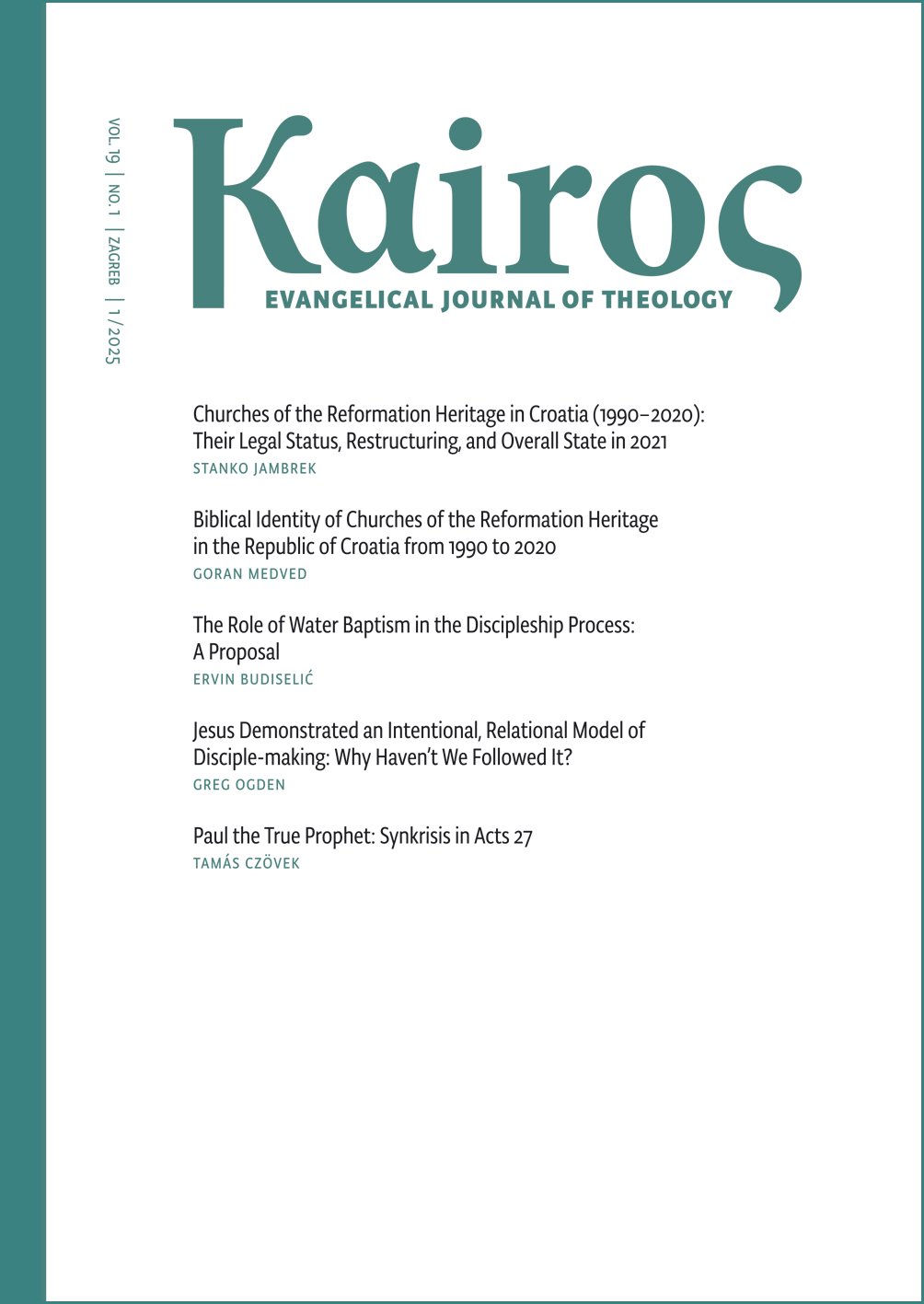
Vol. 19 No. 1 (2025)The new edition of our theological Journal Kairos is out! The first two articles in Kairos give us a look into the research project Evangelical Churches in Croatia (1990–2020). In the first part of the findings, Stanko Jambrek focuses on the legal status, changes, and overall condition of these churches as of 2021. The rest of his findings will be published in the fall edition. Goran Medved explores what shapes the biblical identity of Evangelical churches in Croatia. He highlights their shared commitment to the Bible as the Word of God, while also noting the personal ways believers describe their faith—using terms like “born again,” “saved,” and “children of God.”
The next two articles explore discipleship. Ervin Budiselić looks at how Evangelical churches view water baptism and its role in becoming a disciple. Greg Ogden then reflects on how Jesus approached discipleship. Rather than trying to reach everyone at once, Jesus focused on a small group—teaching and guiding them so they could go on to disciple others.
Tamás Czövek takes a closer look at Acts 27 and the story of Jonah, drawing interesting comparisons between Jonah and Paul—pointing out where they’re similar and where they differ.
Lastly, the issue wraps up with short reviews of recent Christian books by Yevgeny Ustinovich and Kevin J. Vanhoozer.
-
Kairos: Evangelical Journal of Theology
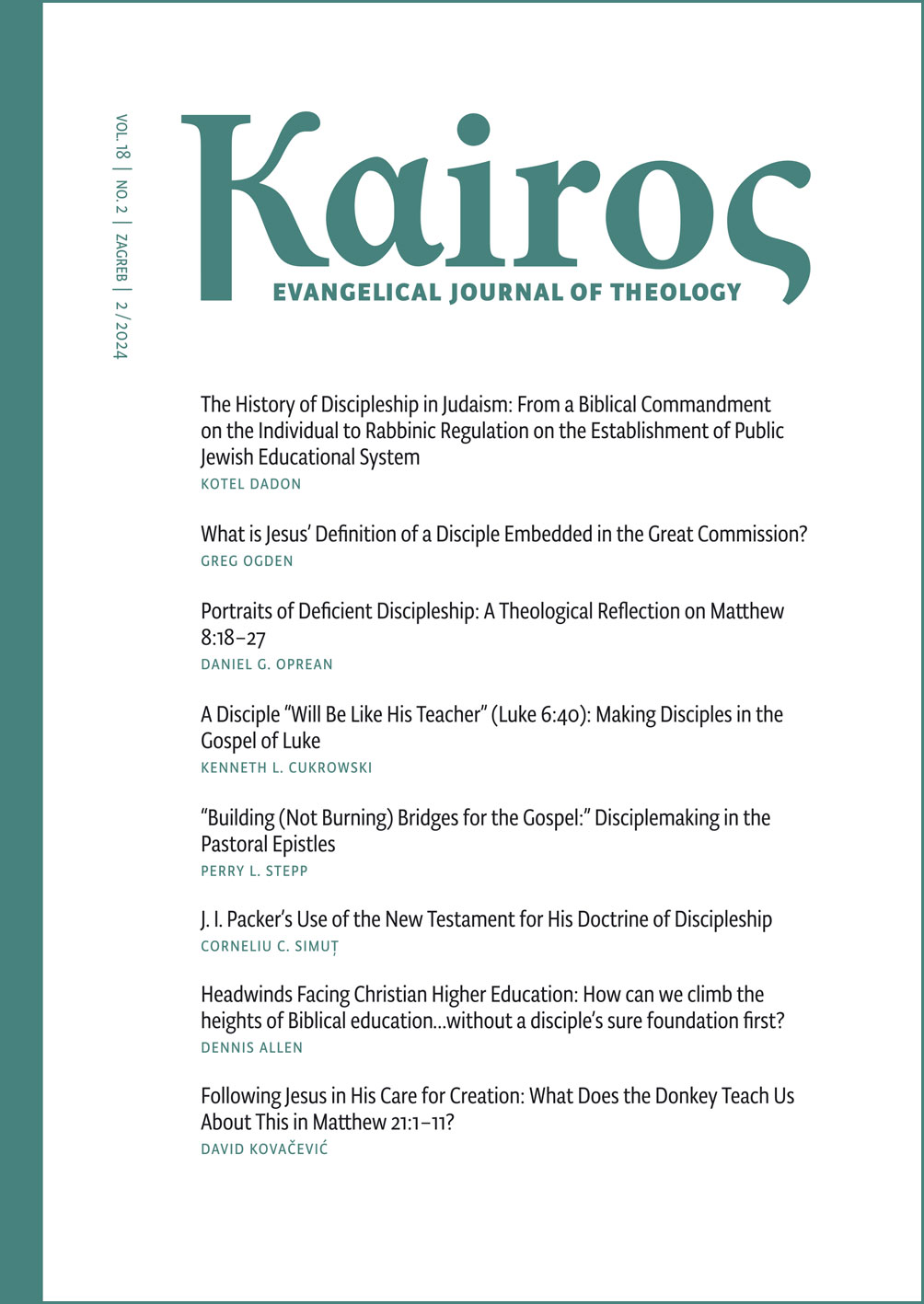
Vol. 18 No. 2 (2024)This time, we present eight articles exploring the theme of discipleship as part of the research project “The Concept of Discipleship Among Evangelical Churches in Croatia” by the Biblical Institute in Zagreb.
Kotel Dadon delves into the history of discipleship in Judaism, focusing on the establishment and development of the public Jewish education system. Greg Ogden examines the characteristics of a disciple of Jesus and whether there’s a difference between a Christian and a disciple. Daniel G. Oprean highlights the shortcomings of discipleship by sketching three portraits of individuals whose discipleship was lacking, as portrayed in the Gospel of Matthew. Kenneth L. Cukrowski, using Luke 6:40, investigates how disciples are shaped.
The Pastoral Epistles (Titus and 1 & 2 Timothy) also address disciple-making, explored further in Perry L. Stepp’s article, "Building (Not Burning) Bridges for the Gospel." Corneliu C. Simuț examines how J. I. Packer, one of the most prominent evangelical theologians of the 20th and 21st centuries, used the New Testament to shape his views on discipleship. In "Headwinds Against Christian Higher Education," Dennis Allen explores the challenges Christian higher education institutions face that threaten their sustainability. Finally, David Kovačević tackles the question: Why does Jesus use a donkey during His entry into Jerusalem, and what does this say about His relationship with creation?
Kairos is published in both Croatian and English and, starting this year, has been indexed in the Scopus database.
-
Kairos: Evangelical Journal of Theology
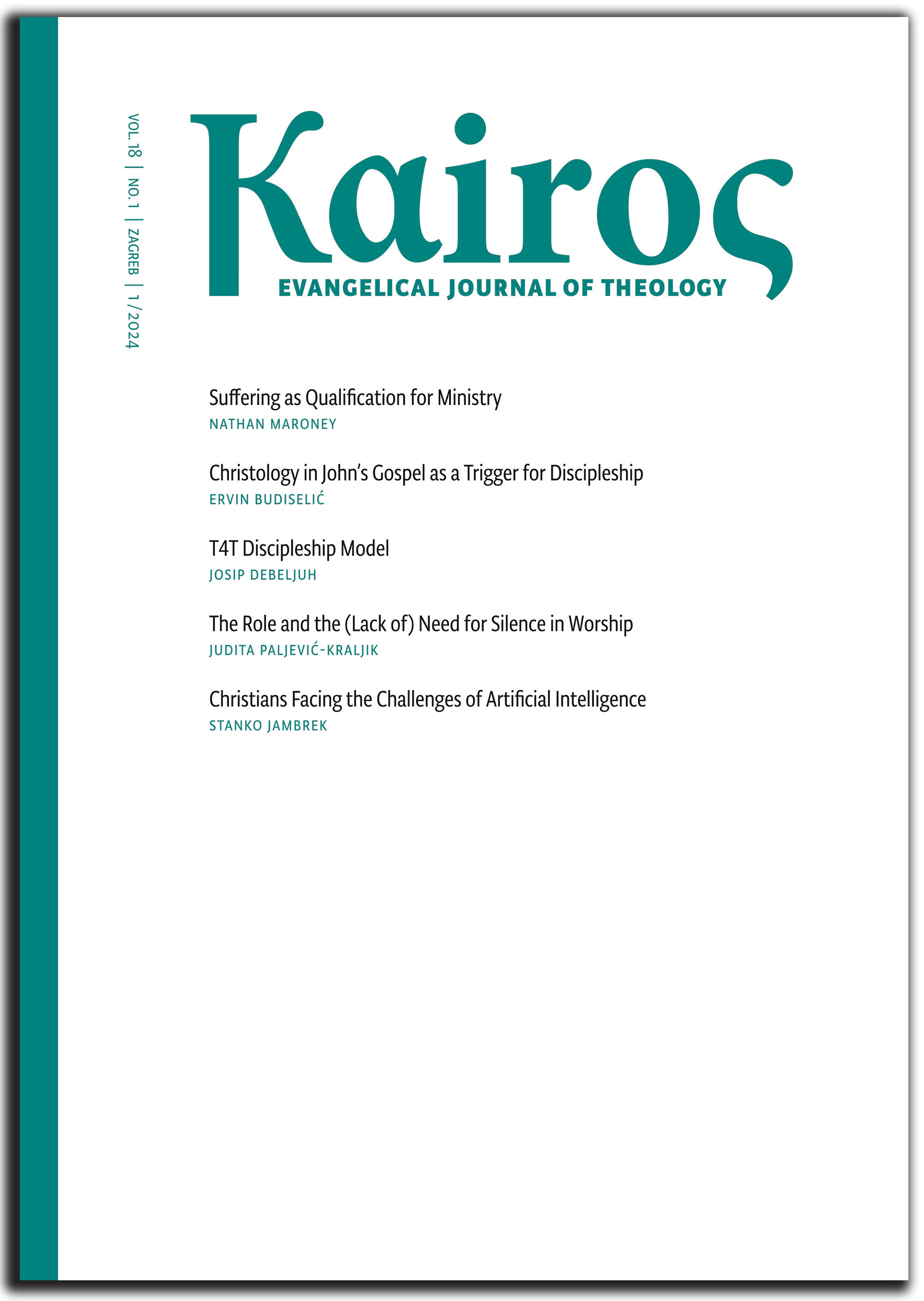
Vol. 18 No. 1 (2024)In the latest issue of Kairos, Nathan Maroney examines Paul's view of suffering, showing how Paul sees it as a way to serve God and advance ministry. Ervin Budiselić examines discipleship through the lens of Christology, emphasizing how Christology acts as the driving force for individuals to become followers of Jesus. Josip Debeljuh explores various discipleship models, with the T4T model (Training for Trainers) standing out for its significant impact on theological seminaries, mission organizations, and churches. Judita Paljević-Kraljik investigates the role of silence in worship—both in personal devotion, church services, and celebrating God through music.
Additionally, Stanko Jambrek reflects on the influence of art in fulfilling humanity's God-given mission (Genesis 1–2) and humanity's desire to be like God as an act of rebellion (Genesis 3, 5).
This edition features reviews of several notable Christian books, including titles such as The Meaning of Singleness: Retrieving an Eschatological Vision for the Contemporary Church and Social Research Methods: For Students and Scholars of Theology and Religious Studies.
-
Kairos: Evangelical Journal of Theology
Vol. 17 No. 2 (2023)This issue covers several themes. In article Life and Reliability of Josephus Boris Havel emphasizing his role as a historian during the First Jewish Revolt and his contributions to understanding Jewish history, theology, and early Christianity. Mark Hamilton, in his work, explores how the Psalms narrate God's kingship and the proper order of the world, which in turn benefits Israel and, through them, the entire world.
Krešimir Šimić discusses three contemporary literary-critical methods applied to biblical poetry. He concludes that biblical poetry is unique and that the distinctions between biblical poetry and prose are not of the same nature as in Western literary culture. Melody Wachsmuth addresses the threats in today's world, as well as the mission and role of the Church in God's ongoing work of reconciliation, healing, and renewal of all creation.
Daniel G. Oprean addresses the theme of discipleship through Joshua's journey out of Moses' shadow and into the Lord's guidance. Continuing the theme of discipleship, Corneliu C. Simuț analyzes and contextualizes various reflections on discipleship by J. I. Packer.
Finally, read the reviews of several current books.
-
Kairos: Evangelical Journal of Theology
Vol. 17 No. 1 (2023)This issue of Kairos (Vol. 17, No. 1, 2023) features four articles addressing various aspects of Bible translation, pneumatology, and discipleship. The opening study highlights the contribution of Fr. Silvije Grubišić as a Bible translator and analyzes his translational choices. The second article explores the theology of Spirit baptism and the gifts of the Spirit in the thought of Martyn Lloyd-Jones, comparing his perspectives with Pentecostal interpretations. The third contribution emphasizes how different approaches to the gospel shape distinct forms of discipleship. The final article discusses the concept of theosis and its significance for discipleship and spiritual growth.
-

Kairos: Evangelical Journal of Theology
Vol. 16 No. 2 (2022)In this issue of Kairos, Gregory Thellman discusses the specifics of evangelical Christianity in Croatia, while Stanko Jambrek reflects on its future. Lidija Ušurel explores the complexity of human identity through the concept of Imago Dei, with relational design at its core. Ervin Budiselić addresses the identity of evangelical believers in the Croatian context in his article "And Which Ones Are You?". Lana Klokočki examines the biblical teaching on the phenomenon of human death, concluding that the Bible often talks about death and does not run from it.
We also feature the history of the Biblija365 mobile app, plus review of In Quest of the Historical Adam: A Biblical and Scientific Exploration (William Lane Craig).

